

Setting Up Your Sphero Classroom
June 29, 2026
What is Coding?
June 30, 2026
Gravity, motion, energy, and thermodynamics are all governed by the laws of physics. The laws of physics control everything from how we walk to how planets orbit the sun, but if one of those fundamental laws suddenly disappeared for a day, what would happen to our world?
Why the Laws of Physics Matter
The laws of physics don’t control how the world works. Instead, they describe how the universe behaves in specific situations. Using these laws, we can predict what will happen when an object moves. These predictions are crucial when engineers design new technologies or transportation methods, like bullet trains or electric cars. The laws of physics help us understand gravity, inertia, friction, motion, and more.
What If Inertia Disappeared?

Newton’s First Law of Motion describes inertia, or momentum. It states that an object at rest stays at rest, and an object in motion stays in motion. When you’re in a car and suddenly brake, your body leans forward because your body is an object in motion, and it wants to stay in motion even though the car is stopping. If inertia disappeared, the car and your body would immediately stop as soon as you lift your foot off of the gas pedal because there would be no momentum to keep the car moving once you stop accelerating. Without inertia, it wouldn’t just be life on Earth that changed. The motion of planets throughout the solar system depends on inertia. Without the momentum to keep Earth spinning on its axis, we could have an eternal day for one part of the planet and an eternal night for the opposite side. None of the planets would move around the sun without inertia, which would throw off every planet’s orbit.
Could We Live Without Gravity or Friction?
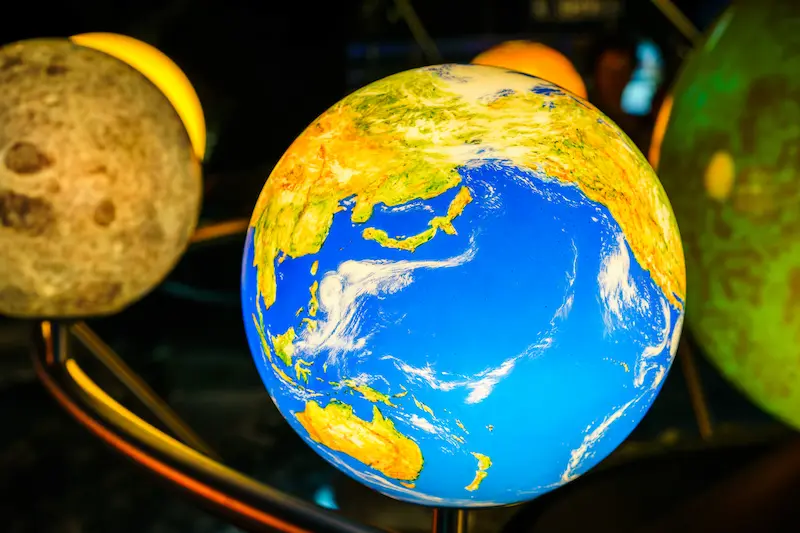
The Law of Universal Gravitation describes the force that keeps your feet on the ground and keeps satellites in orbit. If gravity disappeared for a day, objects resting on Earth’s surface would float away unless they were anchored to the ground. While trees would be able to stay in the ground thanks to their roots keeping them attached, people, cars, and other objects would end up floating into space. Without gravity, the Moon wouldn’t orbit around the Earth. It also means that all the planets would no longer be attracted to the Sun and would no longer orbit around it.
Similarly, friction allows us to hold objects without them simply slipping through our fingers. Friction is the force between two objects when they make contact with each other. Without it, our entire world would be like an ice rink. Walking or driving would be extremely dangerous because everyone and everything would be sliding around.
Thinking Like a Scientist
Scientists use these “what if” questions to understand complex concepts. These questions also encourage students to think about how our world works and imagine what would happen if the rules suddenly changed. This curiosity, combined with theoretical thinking, often inspires new innovations and discoveries, so encourage your students to think about what our world would look like if our understanding of the universe changed.
Why Understanding Physics Matters
The laws of physics may seem ordinary because we experience them every day, but they make life as we know it possible. Imagining a world without inertia, gravity, or friction helps students understand how these forces shape our universe. By exploring hypothetical scenarios, students strengthen their critical thinking skills and deepen their understanding of STEM.
Read more deep dives from STEM to Stern at the links below.




STEM Education Works is dedicated to providing cost-effective and user-friendly access to top-notch STEM curricula and technologies, driven by our mission to transform students’ lives. Learn more about what we do through our socials, Facebook, Twitter, Youtube, LinkedIn, Instagram, and TikTok.