

If aliens landed on Earth today, what one piece of technology would best represent human innovation?
July 6, 2026
Are bananas radioactive?
July 6, 2026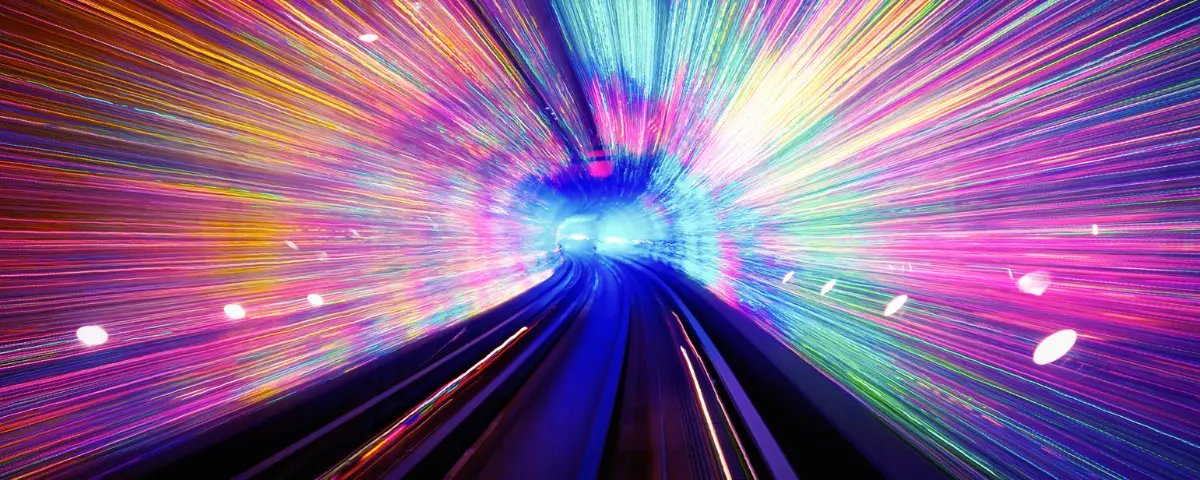
Traveling to distant stars and planets is a common theme in science fiction, but real-world physics prevents interstellar travel from becoming a reality. Other solar systems are so far away that it would take hundreds of thousands of years to reach them unless we could travel faster than the speed of light. According to our understanding of the universe, nothing with mass can travel faster than light. Even though it may seem impossible, physicists have proposed a few theories that could make interstellar travel plausible.
Nature’s Ultimate Speed Limit
Albert Einstein theorized that the speed of light is constant in a vacuum and that nothing with mass can travel faster than the speed of light. The speed of light is 670,616,629 miles per hour. This means a trip to the Moon would take just one second, and traveling to the Sun would only take eight minutes. Due to special relativity, as an object gets closer to the speed of light, its mass increases, meaning that it needs even more energy to accelerate. This effect isn’t noticeable on Earth, but it becomes significant at speeds approaching the speed of light. This means it’s impossible for an object to have enough energy to travel faster than the speed of light.
How Wormholes Could Shorten the Journey
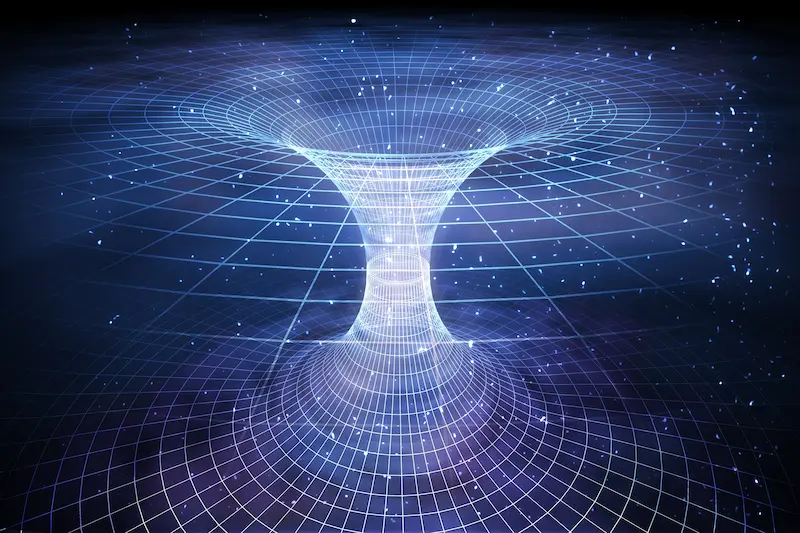
Because the object itself cannot generate enough energy to go the speed of light, physicists theorize that we could travel faster by shortening the distance between two points in spacetime. The fabric of spacetime bends around objects with large mass. This bend in spacetime is responsible for gravity. When the gravity is strong enough that light cannot escape, it creates a black hole, which has been observed in space. A black hole is like a funnel whose end you cannot see because light cannot escape. A wormhole has a strong electromagnetic force at its center, causing a funnel on both ends. In theory, you could travel through a wormhole by entering one end of the funnel and exiting through the other end. By traveling through this tunnel, you’d be traveling faster than light since the gravitational force prevents light from traveling through. Wormholes are purely theoretical, though, and have never been observed. Scientists theorize that even if wormholes did exist, traveling through one would be extremely dangerous, if not impossible, due to radiation and the possibility of collapse. However, many science fiction movies like Interstellar (2014) and Star Trek: The Motion Picture (1979) use wormholes to explain how characters travel faster than light.
How the Alcubierre Warp Drive Could Bend Space
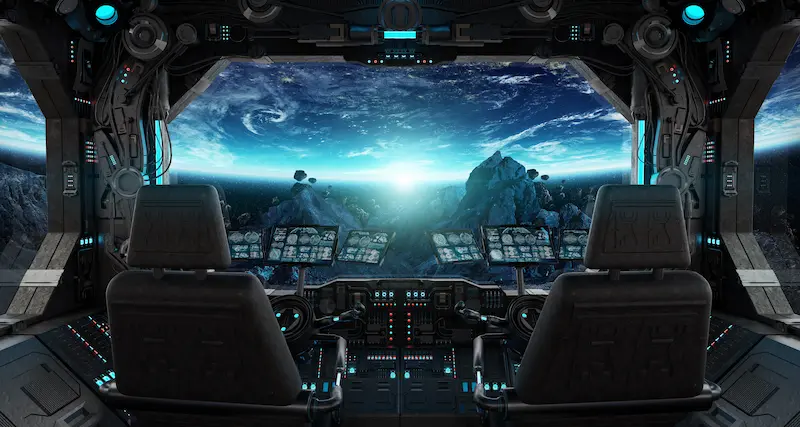
Another theory would involve bending the fabric of spacetime around a spaceship to travel faster than the speed of light. The scientist who invented this idea, Miguel Alcubierre, was inspired by the warp drive from Star Trek. His idea, the Alcubierre Warp Drive, is the concept that a theoretical spaceship could compress the spacetime in front of it and expand the spacetime behind it to travel faster than light. The ship itself wouldn’t technically move faster than light. Instead, space itself would move. This concept is purely theoretical since we don’t have the technology to manipulate gravitational fields. Even if we did have that technology, it would take an enormous amount of energy to create enough gravity to bend spacetime.
Could Humans Ever Colonize Other Star Systems?
Energy is the main problem keeping us from exploring beyond our solar system. Just getting to the Moon is expensive and requires a lot of energy. If we could invent technologies that could provide enough energy to take us to other planets, the journey would take multiple human lifetimes. Traveling faster than the speed of light is key to expanding humanity into the galaxy. If we could travel faster than light using warp drive or a wormhole, humanity could travel to nearby stars and establish colonies beyond our solar system.
Why This Matters for STEM Education
This topic encourages students to think about the future and to transform ideas from science fiction into reality. By discussing light speed and space travel, students learn about physics, astronomy, mathematics, and engineering. Students develop critical thinking skills by learning to distinguish between scientific theories and science fiction. The curiosity of wanting to understand how space travel works in their favorite movies and TV shows inspires students to keep asking questions and testing ideas.
Looking Toward the Future
While wormholes and warp drive remain theoretical, these ideas inspire scientific research. When Einstein wrote his theory, we didn’t have the technology to break the sound barrier. It’s possible that in the future, humanity will have the technology needed to travel faster than the speed of light. Our ambition to visit other planets and other solar systems drives scientists to keep researching and theorizing possibilities.
Read more deep dives from STEM to Stern at the links below.


STEM Education Works is dedicated to providing cost-effective and user-friendly access to top-notch STEM curricula and technologies, driven by our mission to transform students’ lives. Learn more about what we do through our socials, Facebook, Twitter, Youtube, LinkedIn, Instagram, and TikTok.