

Do Theories Ever Become Laws?
June 16, 2026
What’s the weirdest animal adaptation?
June 19, 2026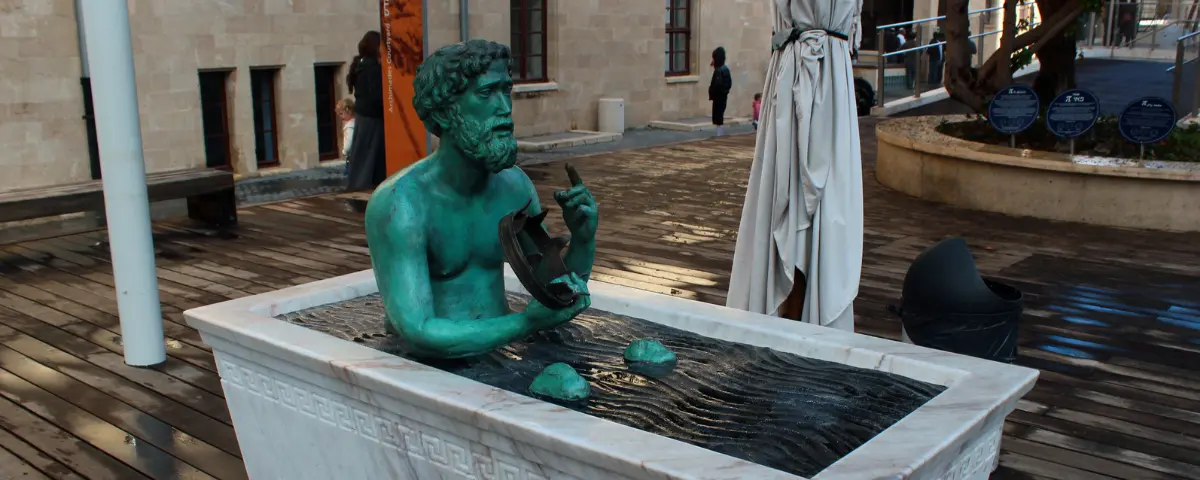
After an important scientific discovery, many scientists still shout, “Eureka!” This phrase comes from the ancient Greek mathematician Archimedes, who shouted it after discovering how buoyancy worked. In ancient Greek, the phrase roughly translates to “I have found it”. This eureka moment shows how scientific discovery is fueled by observation.
Who was Archimedes?
Archimedes lived in the second century BC in Syracuse, Italy. He was a famous mathematician and inventor. He calculated the surface area and volume of a sphere. He also invented the Archimedes screw, which is used to raise water. All these successes led to Hiero, the king of Syracuse, asking for his help. The king had paid a goldsmith to turn a given amount of gold into a crown. Rumor spread that the goldsmith was taking some of the gold for himself and replacing the gold with silver. The king was suspicious, but he couldn’t melt down the crown based on suspicion alone. So, he asked Archimedes to find a way to determine if the crown was pure gold or if the goldsmith had cheated him.
Measuring Weight vs. Measuring Density

The crown weight was equal to the amount of gold given to the goldsmith, but if the goldsmith exactly measured how much gold he took and replaced it with silver, no one would know based on weight alone. When gold and silver are melted together, it’s difficult to tell the difference between the two, so close inspections couldn’t determine if the crown was pure gold. One of the defining characteristics of gold is that it is nearly twice as dense as silver. If Archimedes could calculate the density of the crown and compare it to the density of the gold, he would know if the crown was pure gold. To calculate density, you need an object’s weight and volume. They already knew how much the crown weighed, but measuring its volume was difficult. Archimedes famously calculated the volume of a cylinder and sphere, but the crown was complex, meaning that it would be nearly impossible to accurately calculate volume based on measurements alone. So, Archimedes would need a new way to calculate the volume of a complex object.
Archimedes’s “Eureka” Moment
One day, Archimedes was taking a bath when he discovered the solution to his problem. When he got into the bath, the water rose, and when he left, the water returned to its normal level. This observation was his “eureka” moment. He realized that the volume change must be exactly equal to his volume. According to the story, he leapt out of the bath and ran around Syracuse naked yelling “Eureka! Eureka!” Thankfully, future scientists only adopted the saying “eureka” and not the rest of the story.
Archimedes brought his solution to the king, and they submerged the gold and the crown in water before weighing them again. This test showed that the crown was less dense than the gold, so the goldsmith did steal gold from the king.
The Science Behind Buoyancy

The reason the crown didn’t weigh the same submerged in water as the gold is because of buoyancy. Buoyancy is determined by the density of an object. This is the reason why wood floats but rocks sink when thrown into water. Buoyancy is the force that allows ships to float. The hollow interior of a boat means that the boat is less dense than the water, which allows it to float on top of the water, even if the boat weighs several tons. If the density of an object is less than water, it will float. Otherwise, the object will sink.
Observation Drives Innovation
Before Archimedes’s discovery, people knew how to make ships that floated, but he explained how buoyancy created this phenomenon. His observation in the bathtub shows how innovation can occur at random times and places. Curiosity and careful observation are responsible for many scientific discoveries, so encourage your students to ask questions and record their observations.
Read more deep dives from STEM to Stern at the links below.



STEM Education Works is dedicated to providing cost-effective and user-friendly access to top-notch STEM curricula and technologies, driven by our mission to transform students’ lives. Learn more about what we do through our socials, Facebook, Twitter, Youtube, LinkedIn, Instagram, and TikTok.