

How would time travel work?
June 1, 2026
Exploring the World of AI with the Dobot Magician Lite
June 1, 2026
Computational thinking is a great skill for any student to have, and it’s not just limited to computer science. It is a great way for students to build problem-solving skills that will help them inside and outside of the classroom. Students learn how to break down a problem and analyze the importance of the different pieces, so they can apply what worked to solve one problem to the next. Computational thinking builds the foundation for students to learn how to research, analyze, and solve problems.
What is Computational Thinking?
Computational thinking has four main pillars: decomposition, pattern recognition, abstraction, and algorithmic design. This strategy involves using algorithms to solve problems. Just like a computer uses algorithms to “learn”, humans learn every day and constantly use what we’ve learned to solve new problems.
Decomposition
The first pillar of computational thinking is breaking down a problem into multiple parts, also known as decomposition. This strategy applies to a wide variety of subjects and problems. When reading a story, students have to break down its parts (introduction, rising action, climax, etc.) to identify major themes. When solving a complex algebraic problem, students need to isolate every variable to find the solution. Even event planning requires breaking the work into tasks that individuals need to complete to ensure a successful event.
To bring this idea into your classroom, have your students complete a research project. For a scientific subject, have them choose a relevant issue or problem, then gather data, analyze their findings, and finally, develop a conclusion. For a historical focus, students can choose an event or time period, gather primary sources, analyze them, and summarize their findings. Breaking this project into multiple parts reduces students’ intimidation of large projects. The final deadline doesn’t appear as intimidating if they’ve already completed most of the work in smaller steps.
Pattern Recognition

Pattern recognition is the next pillar, focusing on finding similarities or trends across multiple problems. Students can recall past problems they’ve solved and try to find a solution based on what worked before. Essentially, students are trying to find the underlying rule so they can apply it to different situations. This is especially common in math as students reach more complex algebraic equations. Students learn how to solve a simple algebraic equation, and as the problems become more difficult, they can use the patterns they’ve identified in the simpler equations to solve the more complex ones. Gifted students excel at identifying patterns and quickly finding the “rule” within a pattern.
To challenge older students who are in middle or high school, introduce them to Excel or Google Sheets. Students can use these programs as a tool to identify patterns by creating graphs or charts that organize the data. Computers and artificial intelligence can easily identify patterns in data, but they tend to struggle with the next pillar.
Abstraction
Abstraction is the process of figuring out how to use the different parts of a problem efficiently and accurately. This strategy builds on decomposition. Students have to think about which parts of an issue are relevant when finding a solution and which parts are unnecessary. This is an important skill to have when solving real-world problems. For example, a self-driving car needs to focus on key elements of the road, such as lanes, traffic signs, and other cars. It ignores unnecessary information, such as the colors of other cars on the road or billboards.
To bring this idea into the classroom for elementary students, have them look at a map and simplify it based on key landmarks. This is a great way for students to see that they only need a few key pieces of information to grasp the bigger picture.
For older students in middle or high school, have them try to design an app. Apps need to focus on a single element to avoid overwhelming users. Students can create a wireframe or mockup of the app and explain why they chose to highlight certain features over others.
Algorithmic Design
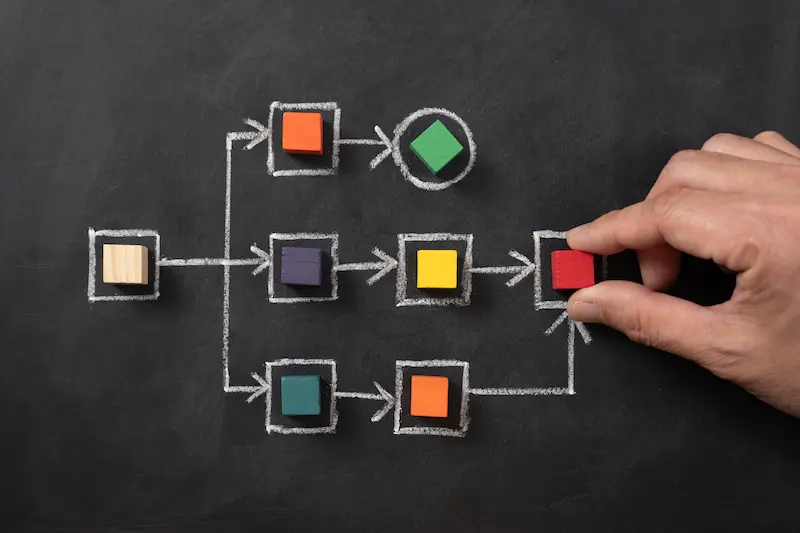
Algorithmic design is the last pillar of computational thinking, and it’s the most important when it comes to coding a robot. This process involves organizing the steps to achieve the desired outcome. This process is essentially creating step-by-step instructions. For a classroom activity, have your students write out detailed instructions. Then, have a student act as a “human robot”. The “robot” is blindfolded and can only listen to the given instructions. This is a great way for students to understand algorithmic design and the level of detail that a robot needs to complete a task correctly.
For older students, have them try to code a simple game or simulation. First, they need to plan the game’s mechanics, such as how players move, how to score points, and how to win. By creating a flowchart before starting to code, students get a better understanding of algorithmic design without being overwhelmed with code. This is a great opportunity to bring computer science technology, like micro:bits or KaiBots, into the classroom, so students can get hands-on experience working with code and seeing their results in real time.
Combining the Four Pillars
To solve large problems, students need to be able to combine all four of these strategies. Challenge your students to develop a detailed plan to address a major community issue. For example, plastic waste is a huge issue across the country. First, have your students break down the problem (decomposition): what factors contribute to excess plastic waste? Next, have them look at recycling and paste usage trends to identify a pattern (pattern recognition). From there, they’ll need to focus on the important factors, like consumer behavior and recycling availability, while ignoring less relevant details (abstraction). Finally, they’ll need to design a step-by-step plan to reduce plastic waste in the community (algorithmic design).
Using this process, students learn how to tackle complex challenges across multiple subjects. Using computational thinking, students can analyze a novel, code a simple game, or solve an issue within their community.
Preparing Students to Solve Real-World Problems
Computational thinking gives students a clear process for solving problems. Students learn how to break down challenges, identify patterns, focus on the important details, and create step-by-step instructions. These skills lead to success across every subject, from math and science to reading and social studies. More importantly, computational thinking prepares students for life outside the classroom. By introducing these skills early and across multiple subjects, educators help students strengthen problem-solving skills that support future careers and everyday decision-making.
STEM Education Works is dedicated to providing cost-effective and user-friendly access to top-notch STEM curricula and technologies, driven by our mission to transform students’ lives. Learn more about what we do through our socials, Facebook, Twitter, Youtube, LinkedIn, Instagram, and TikTok.