

Are centaurs insects since they have six limbs?
May 6, 2026
How would time travel work?
June 1, 2026
STEMgineer’s Guide to Problem Solving Workbooks
What makes your feet stay on the ground? What keeps you from floating away into space? The answer is gravity. Gravity keeps everything grounded on Earth. The simple definition of gravity is the force that pulls objects with mass toward each other. It affects everything from the largest planet to the smallest grain of sand. Although it seems simplistic, physicists still study how gravity works and debate whether gravity is even a force.
Gravity is a Fundamental Force
Gravity is one of the four fundamental forces that keep everything in our universe working. These forces explain how matter interacts.
- Gravity pulls all objects with mass toward each other.
- Electromagnetism acts on particles with opposite charges (positive and negative).
- The strong nuclear force holds the nucleus of an atom together.
- The weak nuclear force changes subatomic particles, such as turning a proton into a neutron.
Although gravity keeps all the planets in orbit, it’s actually the weakest force of the four. However, it has the greatest range, which controls how planets, stars, and galaxies move.
Isaac Newton’s View on Gravity
In the late 1600s, Isaac Newton developed gravitational theory. He theorized that celestial bodies were kept in orbit by gravity, the same force that causes an apple to drop to the ground. He introduced the idea that gravity is a force that pulls objects together based on their masses and the distance between them. This theory is still taught today and accurately explains how gravity works on Earth. However, later scientists found flaws when they tried to apply Newton’s theory to specific cases in space.
Albert Einstein’s Alternative Perspective

In the early 1900s, Albert Einstein theorized that gravity is not a force but the result of curved spacetime. Essentially, massive objects, such as planets and stars, can bend the fabric of spacetime around them. Other objects follow these curves like passengers on a rollercoaster riding along a predetermined track. While this looks like a force is pulling an object, the object is actually moving along a predetermined track.
Ongoing Questions About Gravity
While we have two main theories of what gravity is, physicists still debate its origin. Some scientists propose that particles called gravitons carry gravitational effects. Just as photons are responsible for electromagnetism, gravitons would be the particles that pull two objects together. While science has not found these particles, physicists hypothesize that these particles would be massless and move at the speed of light.
Since we haven’t found gravitons, other physicists believe that gravity is an illusory force. Einstein established that spacetime can curve around planets, forcing objects to follow those curves. This means that gravity isn’t actually a force, but it’s just a coincidence.
This debate shows that science is still changing and developing every day. Although we think we know everything about how our universe works, there’s still a lot we don’t know.
Gravity and Scientific Discovery
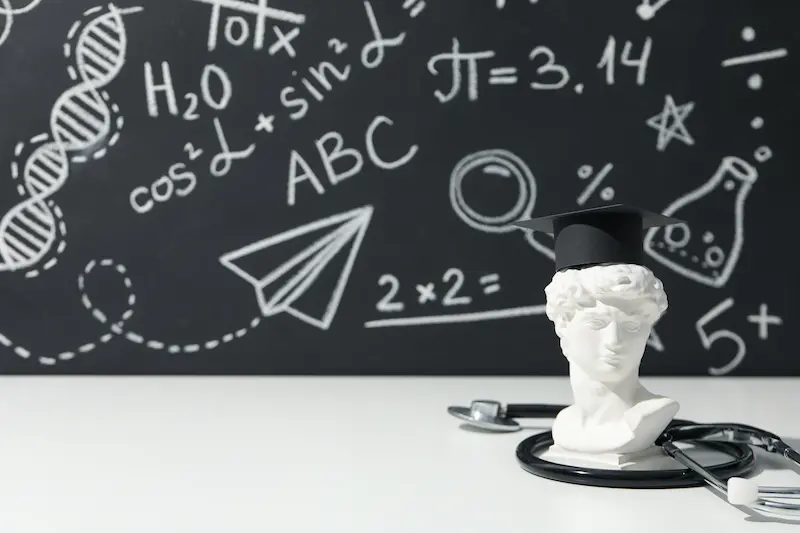
Gravity subtly plays a role in everything we do on Earth, but we are still learning and debating how it works and even what it is. It’s important to question even seemingly simple things, because scientific explanations are always evolving as we learn more. By questioning how things actually work and thinking critically, your students could become the next generation of scientists and physicists who fuel exploration.
Read more deep dives from STEM to Stern at the links below.


STEM Education Works is dedicated to providing cost-effective and user-friendly access to top-notch STEM curricula and technologies, driven by our mission to transform students’ lives. Learn more about what we do through our socials, Facebook, Twitter, Youtube, LinkedIn, Instagram, and TikTok.