
Building the Future in Greater Lafayette and Beyond
December 17, 2025
AI in the Classroom: Teaching with Integrity in the Age of Artificial Intelligence
February 3, 2026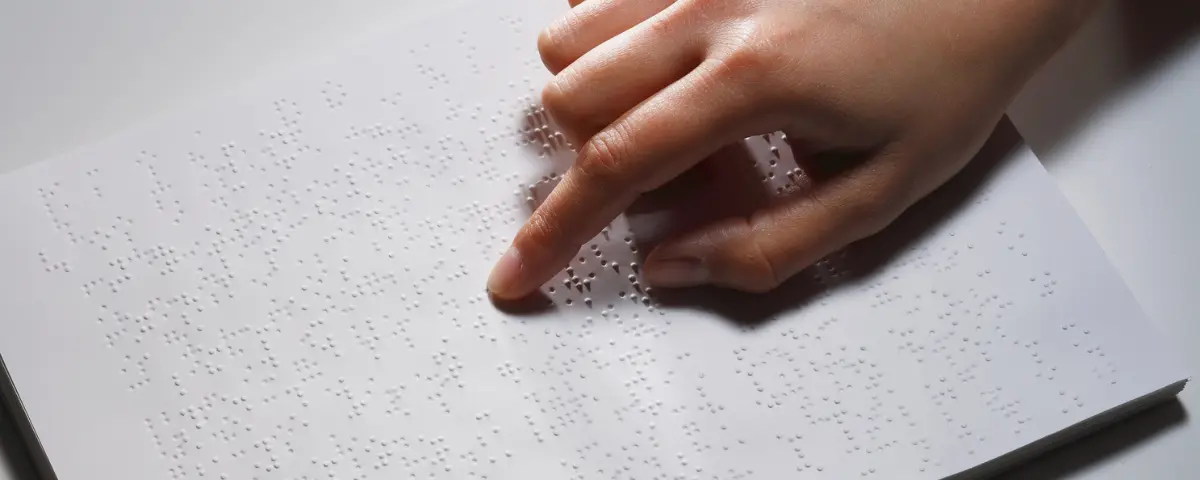
Every year on January 4th, people around the globe celebrate World Braille Day, a day recognizing the importance of braille while advocating and educating for equal rights for people who are blind or visually impaired. The date was selected because it is the birthday of Louis Braille, the inventor of the tactile writing system that now bears his name.
But World Braille Day is more than a date on the calendar, It’s a reminder that innovation and inclusion go hand in hand. So, let’s do some exploring about what World Braille Day is, how braille itself is a powerful STEM innovation, and share practical activity ideas you can use to celebrate in your classroom or makerspace.
What is Braille, Really?
Braille is a tactile writing system that uses patterns of raised dots arranged in a six-dot cell. Different combinations of dots represent letters, numbers, punctuation, and even mathematical, musical, and scientific symbols. (Malagen)
For many people who are blind or visually impaired, braille is literacy; the way they read novels, take notes, enjoy a comic book, and study textbooks. In other words, braille is to touch what print is to sight.
Braille is also a quietly brilliant example of early STEM thinking:
- It’s based on pattern recognition and combinatorics (how many symbols can you make from six dots?).
- It has specialized “codes” for math and science, emphasizing the importance of accessible STEM literacy.
- It inspired generations of assistive technology, from mechanical braille writers to today’s refreshable braille displays that convert digital text into tactile characters using tiny moving pins. (Braille Music & More)
Why World Braille Day Belongs in STEM Classrooms
World Braille Day’s purpose is simple but powerful: to highlight how vital braille is for independence, education, and participation in society.
That mission lines up perfectly with STEM education goals:
- Problem-solving: Braille was created by a teenager trying to solve a communication problem. That’s design thinking in action.
- Equity and access: Accessible materials allow more students to participate in STEM subjects, and eventually in STEM careers. Research on accessible STEM materials emphasizes strategies like tactile graphics, clear descriptions, and accessible digital tools to support learners with disabilities. (AEM Center)
- Real-world engineering: Modern assistive technologies; screen readers, braille displays, haptic devices, and accessible robots are all designed and built by engineers and computer scientists. (The American Foundation for the Blind)
Framing World Braille Day through a STEM lens lets students ask big questions:
How do we design technology that works for as many people as possible? What does it mean to “engineer for everyone”?
STEM-Focused Ways to Celebrate World Braille Day
You don’t need a braille embosser or specialized equipment to bring World Braille Day into your STEM space. Here are several activity ideas, organized roughly from elementary to secondary, that emphasize hands-on learning and inclusive design.
1. Decode & Design: Braille Name Tags (K–5)
STEM focus: Patterns, binary thinking, basic engineering design
Materials:
- A printed braille alphabet chart
- Cardstock or index cards
- Stick-on gems, puff paint, pony beads, or small adhesive dots
- Markers
- Introduce braille using a simple chart and explain that each letter is made from combinations of six possible dots. (Malagen)
- Have each student encode their name in braille on paper, then build a tactile version on a card using beads or dots.
- Invite students to debug their patterns by checking each other’s name tags against the chart.
STEM connection:
You can link braille to binary code, each dot is either raised (on) or not (off), just like bits in a computer system. This is a fun way to help younger students see how patterns and codes show up in both accessibility and computer science.
2. 3D Printing Braille & Tactile Models (3–12)
STEM focus: Engineering design, 3D modeling, accessible science
3D printing is a natural fit for accessible STEM, making complex concepts touchable: maps, molecules, geometric solids, and more. Organizations like Perkins School for the Blind and Accessible Graphics have shared extensive guidance and model ideas for tactile learning with 3D printed objects. (Perkins School for the Blind)
Project ideas:
- Braille “mini dictionaries”:
Design small tiles with a print letter on one side and braille on the other. Students can use Tinkercad or another beginner-friendly CAD tool to design the tiles, then print and assemble them into a key ring or vocabulary set.
- Science concepts you can hold:
- 3D water cycle tiles with braille labels for each stage
- Tactile models of planets, phases of the moon, or cell structures
- Geometry manipulatives (prisms, pyramids) with braille labels on the faces
Design challenge prompt:
Ask students to choose a topic from your current unit and design a tactile model that would help a blind student understand it. Encourage them to test their designs by closing their eyes and trying to interpret only by touch, then refine based on what they learn.
Celebrating World Braille Day Thoughtfully
As you plan your World Braille Day activities, here are a few ways to keep the celebration respectful and inclusive:
- Center lived experience. If you have students who use braille, invite them (if they’re comfortable) to share what works for them, but never put them on the spot or treat them as representatives for all blind people.
- Avoid “inspiration” language. Focus on access, rights, and design, not on portraying disabled people as inspirational simply for existing.
- Use accurate, respectful language. “Blind,” “low vision,” and “visually impaired” are all commonly used; when in doubt, follow the language your students and local community prefer.
- Make accessibility an ongoing practice, not a one-day theme. World Braille Day can be a launchpad for long-term changes—like adding tactile labels in your STEM lab, offering digital materials that work with screen readers, or choosing tools with built-in accessibility features. (AEM Center)
How STEM Education Works Can Support Inclusive STEM
Creating accessible STEM experiences doesn’t have to be overwhelming. At STEM Education Works, we specialize in hands-on STEM tools, curriculum, and professional learning that help you bring real-world, inclusive STEM to your students across robotics, 3D printing, laser cutting, computer science, renewable energy, and more. (STEM Education Works)
From coding robots that pair with braille coding cards to 3D printing and laser cutting tools for tactile models, we’re here to help you build a STEM program where every learner can explore, invent, and belong.
World Braille Day is a perfect moment to ask:
What would our classroom look like if we designed every STEM activity with accessibility in mind?
If you’re ready to explore accessible STEM options for your school or program, reach out to us. We’d love to be your partner in building STEM spaces where every student can thrive.