

Leading Innovation: Interview with Marla Rosenthal
June 1, 2021
GEARing UP For STEM with the EV Micro-Kart!
June 23, 2021
“Early coding, or precoding, offers children experiences that integrate communication, thinking, and problem-solving. These are 21st-century skills that are valuable for children’s future success in our digital world.” – Deanna Pecaski McLennan, NAEYC
Language of the Future
Coding is the language of computers, and computers are everywhere. From your home lights to your coffee maker to your smartwatch, coding is involved in so much of what we do daily.
What does the term “coding” actually mean? It’s the simplest set of commands that are combined into a program and then fed into your computer to complete tasks. Because programs run all of those things, knowing the language helps you better understand the world around you.
Coding also requires higher-order thinking skills, such as problem-solving, critical thinking, and analysis. These are skills we all want our students to possess. On top of that, many of the fastest-growing careers require coding knowledge, such as software engineering and computer programming.
Start Coding Early
Research shows that preschool is the optimal time for literacy. Reading, writing, and moving from oral to written expression. This is one of the reasons why parents are encouraged to read to their children as early as birth (or even before)!
The building blocks of language and literacy form in the first few years of a child’s life. The first years of life are marked by intense brain activity (by age three, a child’s brain is twice as active as their parents’). Preschool students are forming brain connections through their senses, and the more activities they experience, the more connections their brains form.
This is why there is such a push to have young children learn a foreign language. Students from the University of Washington found that “Bilingual experience has been shown to improve cognitive abilities, especially problem-solving.” Although many people (the author included) don’t believe coding should replace foreign language instruction, it certainly can supplement and support literacy learning. A spoken language can have tens of thousands of words, while a typical programming language has about 100 words, with the challenge being how to combine them to create complex programs.
That is the kind of work that is perfect for preschool-level literacy learning. The NAEYC stated,
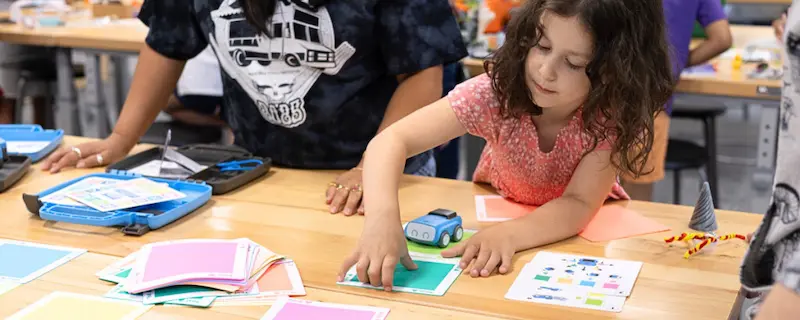
“Coding is like a game. It’s very engaging for children who enjoy telling stories and using grids and maps. Children ages 3 to 5 can create drawings of maps that represent relationships between objects and places. When we incorporate programming into early learning settings, we immerse children in versatile activities that align with standards in multiple areas, such as math, problem-solving, communication, and literacy. Precoding activities offer children opportunities for interaction and collaborative learning, as well.”
How To Code With Preschoolers
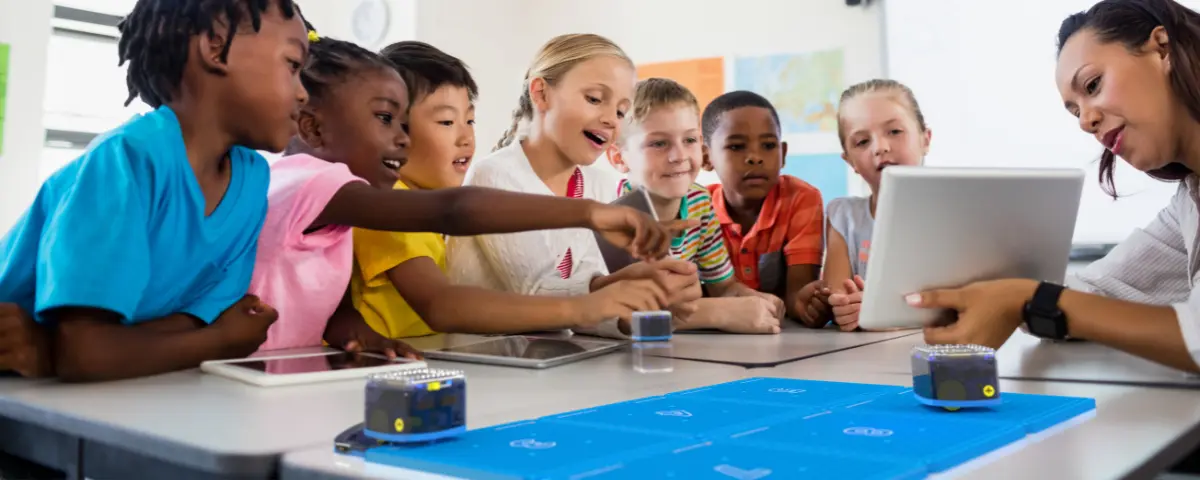
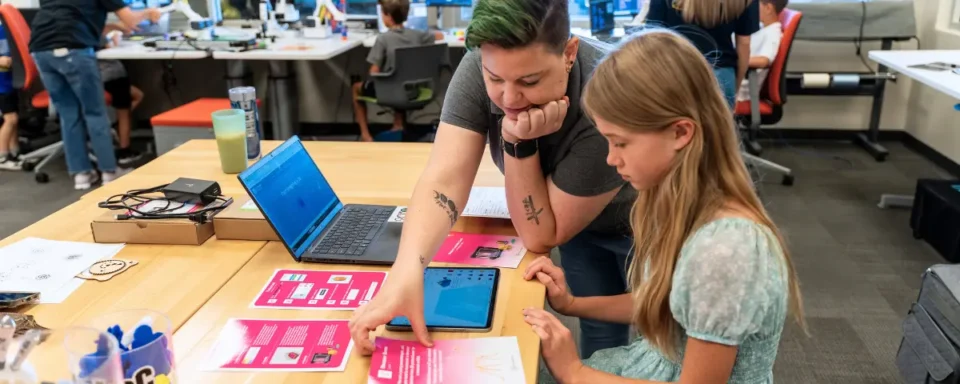
Coding doesn’t have to involve computers, especially at the beginning. The process of decomposition, or breaking large tasks into smaller ones, is involved in many of the games children play.
Here are some other resources for “unplugged coding” from Kodable:
- Have a student or teacher act as a “robot.” Give the robot a task and have students provide step-by-step instructions. A fun example is shooting a basketball. Students will learn very quickly that they must be detailed in their instructions. You can find this activity in our Sphero K-5 Curriculum!
- Give students paper and have them fold it into the shape of a fish (no instructions, designs, or other guidance). Discuss the results. Then give them clear directions and repeat the activity. Students learn that step-by-step instructions make things simpler and faster.
- Play follow the leader. With students divided into pairs, one student gives directions to the other using IF/THEN statements, such as, “If I clap my hands three times, you jump up and down twice.” This is a straightforward and fun way to teach conditionals.
You can even utilize board games to teach the fundamentals of coding without a computer!
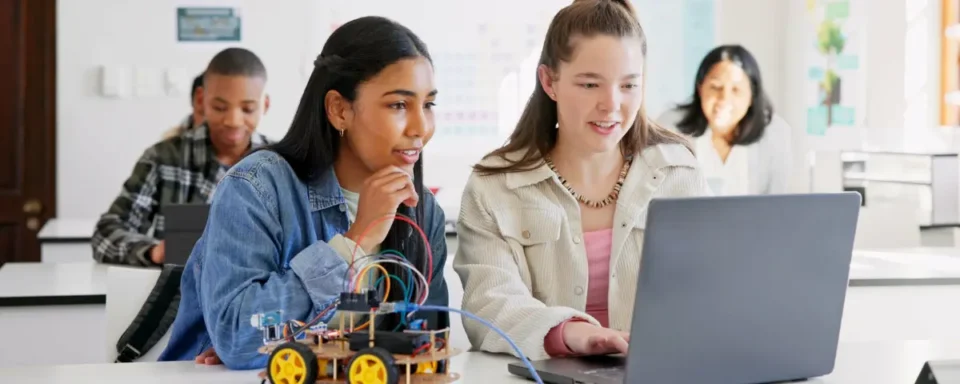
If you want to infuse technology into your pre-school coding instruction, check out these tools:
However you decide to incorporate coding, know that your students will learn essential skills that will not only prepare them for kindergarten but also for life.
STEM Education Works provides educators and youth advocates with the hands-on tools, curriculum, and training to bring STEM learning to life. From coding and robotics to 3D printing and laser cutting, their solutions spark curiosity, build real-world skills, and prepare students for the future. Learn more about what we do through our socials, Facebook, Twitter, YouTube, LinkedIn, Instagram, and TikTok.